
What’s New in the UK Student Visa Policy?
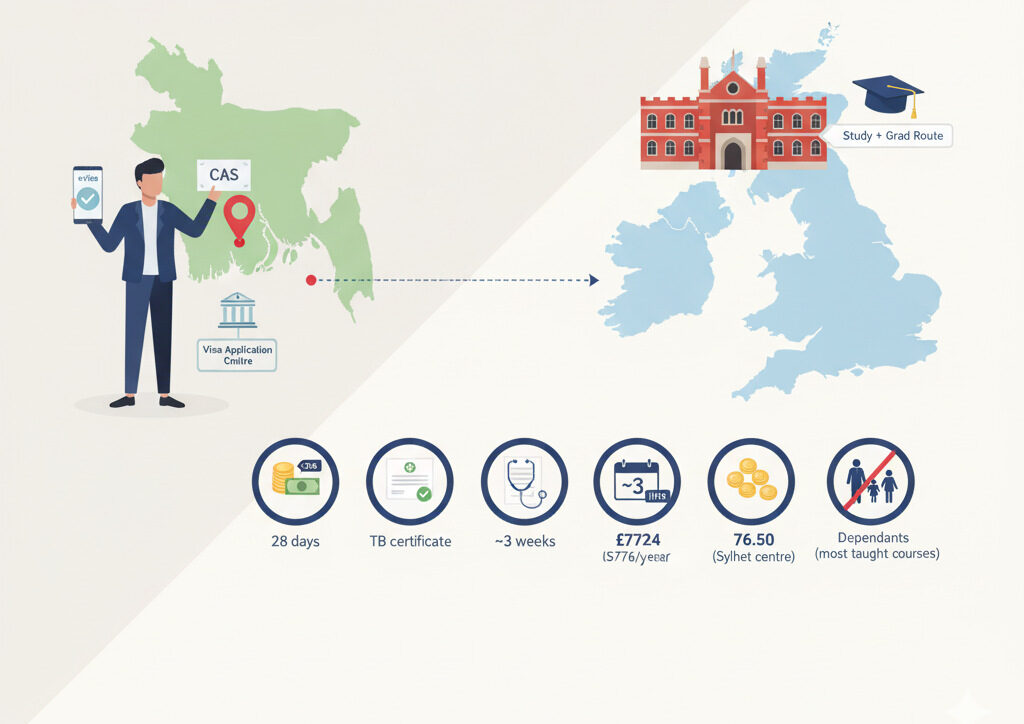
For decades, the United Kingdom has been the premier destination for students seeking world-class education and global career mobility. However, as we move through 2026, the landscape has fundamentally shifted. The UK Home Office has introduced a suite of policies designed to prioritize “high-value” students while aggressively curbing migration numbers.
If you are applying from Dhaka, Sylhet, or Chittagong this year, you are entering the most competitive and scrutinized visa environment in recent history. This guide breaks down the critical changes you must master to secure your future.
1. Why Your Choice of University is Now Your Biggest Risk
In late 2025, the Home Office implemented a drastic change to the Basic Compliance Assessment (BCA). Previously, UK universities were allowed a 10% visa refusal rate before their licenses were at risk. In 2026, that threshold has been slashed to 5%.
The Impact on Bangladesh
Because refusal rates for Bangladeshi applicants reached nearly 22% in previous years, many “Tier 4” sponsors are now in a state of panic. To protect their ability to recruit international students, many universities have:
- Blacklisted Specific Regions: Some institutions have temporarily stopped issuing CAS (Confirmation of Acceptance for Studies) to students from specific districts in Bangladesh known for high visa fraud or “non-genuine” intent.
- Extreme Pre-CAS Interviews: You will likely face a university interview that is more rigorous than the actual embassy interview. They will grill you on “Why this specific module?” and “How does this justify a £20,000 investment?”
The Strategy: Do not apply to “high-risk” universities that are currently under Home Office “Action Plans.” Stick to Russell Group or high-ranking modern universities that have the administrative capacity to support your application.
2. Financial Requirements
The cost-of-living crisis in the UK has forced the Home Office to increase the maintenance requirements (proof of funds) significantly.
| Location |
Monthly Requirement |
Total for 9-Month Course |
| Inside London |
£1,529 |
£13,761 |
|
Outside London |
£1,171 |
£10,539 |
Critical Changes in Fund Verification
In 2026, it will no longer be enough to have the money. The Home Office has increased scrutiny on the Source of Funds:
- Bank Authenticity: Only specific UKVI-approved banks in Bangladesh (e.g., Standard Chartered, HSBC, Prime Bank, BRAC Bank) are trusted. Using a non-approved cooperative or small rural bank is an automatic refusal.
- The 28-Day Rule 2.0: While the 28-day rule remains in effect, visa officers are now cross-referencing large deposits made just before the 28-day window begins. If you cannot explain where a 20-lac Taka deposit came from (e.g., land sale documents or business profit), your visa could be refused under the new “Part Suitability” rules.
3. The Graduate Route 18-Month Rule
One of the most significant changes for 2026 involves the Graduate Visa (Post-Study Work). The UK government is moving to shorten the “stay-back” period for graduates to help them transition into skilled work more quickly.
- The December 31, 2026 Deadline: If you apply for your Graduate Visa on or before this date, you will still receive the complete 2-year stay (3 years for PhD).
- The January 1, 2027 Shift: For applications made after this date, the period for Bachelor’s and Master’s graduates will be reduced to 18 months.
- The PhD Advantage: Doctoral students remain unaffected and will continue to receive a 3-year stay, as the UK seeks to retain high-level research talent.
Strategic Tip: If you are starting a one-year Master’s in January 2026, your “race against time” begins the moment you land. You must ensure you complete your course and apply for your PSW before the December deadline to lock in that extra 6 months of work rights.
4. English Proficiency: The B2 Standard and the Skilled Worker Transition
While many universities still accept an IELTS score of 6.0 (B2) or even 5.5 (B1) for admission, the Skilled Worker Visa, the primary route for permanent residence in the UK, now has a new hurdle.
- Effective January 8, 2026: All new applicants for the Skilled Worker, High Potential Individual (HPI), and Scale-up routes must meet a Level B2 requirement (equivalent to IELTS 5.5-6.5 in all four components).
- Why this matters now: Many Bangladeshi students previously struggled to switch from a student visa to a work visa because their English wasn’t high enough. In 2026, you should aim for a minimum 6.5 in IELTS before leaving Bangladesh to ensure you don’t face a “dead end” when trying to switch to a work visa later.
5. The Death of the BRP: Embracing the eVisa
As of 2026, the physical Biometric Residence Permit (BRP) is officially a thing of the past. The UK immigration system is now Digital by Default.
- Your UKVI Account: Once your visa is granted in Bangladesh, you will not receive a plastic card. Instead, your status is linked to your passport digitally.
- Mandatory Step: You must create and maintain a UKVI account. This is how you will prove your right to work to employers and your right to rent to landlords.
- Travel Requirement: You will still receive a 90-day vignette (sticker) in your passport to enter the UK, but after that, your smartphone is your visa.

6. The Genuine Student Test
The Home Office has replaced the old “General Grounds for Refusal” with a more aggressive “Part Suitability” framework. This gives visa officers more discretion to refuse you based on:
- NHS Debts: If you were in the UK before and left an unpaid medical bill, you will be refused.
- Immigration History: Even minor overstays in other countries (such as Malaysia or Dubai) are now flagged more effectively through global data sharing.
- Study Gaps: If you have a gap of more than 2-3 years since your last education, you must provide a bulletproof, evidence-backed explanation of what you were doing and why you are returning to study now.
7. The Dependant Ban: A Hard Reality
The ban on bringing dependants (spouses and children) that started in 2024 remains strictly in place for 2026.
- Exceptions: Only students on Government-sponsored scholarships or those enrolled in PhD or Research-based Master’s programs can bring family members.
- The Warning: Attempting to use a “care-worker” visa or other side-routes to bring family while studying is being heavily monitored and often leads to visa cancellations.
Summary Checklist for Bangladeshi Students
- University Research: Choose a university with a refusal rate well below 5%. Ask for their “BCA status” before paying a deposit.
- IELTS Prep: Aim for 6.5+ even if the university asks for a lower score. This protects your future work visa switch.
- Financial Integrity: Hold your funds (approx. 35-40 lac BDT, depending on fees) in a UKVI-approved bank for at least 31 days before the application date to ensure safety.
- TB Testing: Book your IOM (International Organization for Migration) appointment in Dhaka or Sylhet at least 2 months in advance, as slots are filling up faster in 2026.
- Digital Readiness: Ensure the email and phone number you use for the application are permanent, as they will be your “key” to your digital eVisa for years to come.
Quality Over Quantity
The 2026 UK Student Visa policy is designed to filter out those who are “migrating for work” and welcome those who are “migrating for skill.” If you can prove you are a serious academic with the financial means to support yourself, the UK remains the most rewarding destination in the world. However, even a minor error in your financial documentation or a weak interview can result in a 10-year ban under the new suitability rules.